



Stock Turnover Ratio (Inventory Turnover) Explained: Meaning, Formula, Examples & Best Practices


If you run a product business in the UK, retail, ecommerce, wholesale, or manufacturing, inventory can feel like a blessing and a burden. Too much stock ties up cash. Too little stock causes missed sales. That’s why understanding the stock turnover ratio (also called stock turnover) matters.
In this Trustlogix guide, you’ll learn the inventory turnover meaning, how the inventory ratio formula works, how to calculate inventory turnover step by step, and how to use the results to improve inventory control and profits. We’ll also cover inventory valuation, why it affects your numbers, and how to convert turnover into inventory turnover days so the metric is easier to understand.
What Is Inventory Turnover (Stock Turnover)?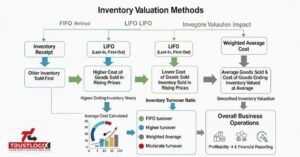
Inventory turnover: meaning in simple terms
The inventory turnover’s meaning is straightforward:
Inventory turnover tells you how many times your business sells and replaces stock over a period (often a year). In other words, it shows how quickly you move stock.
If you’re asking what inventory turnover is, think of it as a speedometer for your stock. A higher number usually means you’re selling faster, but it can also mean you’re understocked. A lower number can mean slow sales, overbuying, old products, or weak demand.
You’ll also see related phrases like:
- rate of inventory turnover (same idea, how fast stock is moving)
- inventory turnover ratio (the common accounting term)
- inventory rotation (operations language for moving older stock first)
Inventory turnover vs stock turnover vs inventory rotation (are they the same?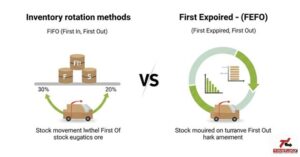 Most of the time:
- Inventory turnover = stock turnover ratio = the same KPI (finance/accounting term)
- Stock turnover = a shorter version used in business and retail
- Inventory rotation = more of a warehouse process (e.g., FIFO) that helps improve turnover
So yes, these terms overlap. But there’s a useful difference:
- Turnover is a number (a ratio).
- Rotation is a method (how you manage stock flow, like FIFO).
Why the Rate of Inventory Turnover Matters (Cash Flow + Stock Control)
A good inventory turnover calculation is more than a textbook KPI. It affects real-world decisions in your supply chain, buying, storage, pricing, and cash flow.
How turnover connects to inventory control management
Your inventory control management system is meant to answer questions like:
- Do we have enough stock to meet demand?
- Are we buying too much?
- Are we holding older stock for too long?
- Are our reorder points right?
Inventory turnover helps you measure whether your inventory control is working. It links directly to:
- working capital management (cash tied up in stock)
- storage and inventory costs
- inventory accuracy (bad data ruins the metric)
- The cash conversion cycle (CCC) and how long your cash is trapped in products
In simple terms: the faster you sell and replace inventory (without stockouts), the faster your money can come back to you.
What turnover can signal (overstocking, weak demand, understocking)
Inventory turnover can reveal problems early. Here’s what it may signal:
If turnover is low
- Overstocking (too much stock for the demand)
- Poor product-market fit
- Pricing issues
- Too many slow movers / dead stock
- Weak promotions
- Too much variety (SKUs that don’t sell)
- High inventory carrying costs and increased risk of uselessness
If turnover is high
- Great demand and fast-selling products (high inventory turnover)
- Lean inventory and strong replenishment
- Or frequent stockouts and missed sales (especially if lead times are long)
That’s why the “best” turnover rate depends on your category, margin, lead time, and customer expectations.
Extra Trustlogix tip: Don’t judge turnover alone. Pair it with:
- stockouts and backorders
- service level/fill rate
- gross profit margin (fast sales don’t always mean good profit)
Inventory Ratio Formula: Inventory Turnover Calculation
Stock turnover ratio formula (COGS ÷ average inventory)
Here’s the most used inventory ratio formula:
Inventory Turnover Ratio = Cost of Goods Sold (COGS) ÷ Average Inventory
This is the standard stock turnover ratio formula used in accounting and finance.
You’ll also hear people say “goods sold cogs” (they mean cost of goods sold), which is the cost you paid to buy or make the items you sold.
Key pieces you’ll need:
- cost of goods sold (COGS) (from your income statement / P&L)
- average inventory (from your balance sheet or inventory records)
Should you use COGS or sales? (best practice + consistency)
Some businesses use sales in the numerator, but the best practice is COGS, because:
- COGS and inventory are measured at cost (they match)
- Sales include markup and can distort comparisons
If you do use sales, keep it consistent and be clear in reporting. Most standard references and UK finance teams prefer COGS ÷ average inventory for cleaner analysis.
How to Calculate Inventory Turnover (Step by Step)
Below is a simple method you can use monthly, quarterly, or yearly. The key is to keep the time period consistent.
Step 1: Find COGS (where to get it)
To calculate inventory turnover, you first need COGS for the same period.
Where to find it:
- Your profit and loss statement (P&L): “Cost of Sales” / “Cost of Goods Sold.”
- Accounting software reports
- Management accounts
If you don’t have a clean COGS line, you may estimate with:
COGS = Beginning inventory + Purchases − Ending inventory
This approach is common in inventory accounting basics.
Also consider:
- supplier purchase price
- freight and landed costs (if included in inventory)
- write-downs (obsolete or damaged stock)
Step 2: Find average inventory (how to calculate it)
Next, you must find the average inventory.
Most businesses use a simple average:
Average inventory = (Beginning inventory + Ending inventory) ÷ 2
This is a standard approach and is widely used in practice.
If your stock rises and falls a lot (seasonality, promotions, peak periods), a two-point average may be misleading. In that case, calculate the average using monthly values.
Step 3: Calculate the inventory turnover ratio
Now apply the formula:
Inventory turnover ratio = COGS ÷ average inventory
That number is your rate of inventory turnover for the period.
Example quick interpretation:
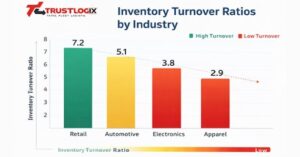
- 2 turns/year = slow movement (depends on industry)
- 6 turns/year = strong movement for many retailers
- 12 turns/year = very fast movement (common in grocery/FMCG)
Remember: “good” depends on your category. Benchmarks vary widely by industry and model.
Inventory turnover example (with numbers)
Let’s use a simple UK example (annual):
- COGS (Cost of Sales): £600,000
- Beginning inventory (1 Jan): £110,000
- Ending inventory (31 Dec): £130,000
Step A: Calculate the average inventory
Average inventory = (£110,000 + £130,000) ÷ 2
Average inventory = £240,000 ÷ 2
Average inventory = £120,000
Step B: Calculate inventory turnover
Inventory turnover ratio = £600,000 ÷ £120,000 = 5
Meaning: you sold through your average stock about 5 times per year. That’s a solid result for many UK retail and ecommerce operations, as long as you’re not constantly running out of stock.
Trustlogix check: Compare turnover with your stockouts. If your top SKUs are always missing, turnover may look great while revenue suffers.
How to Find Average Inventory (and Why Inventory Valuation Matters)
This section is where many businesses go wrong. The math is easy, but the inputs can be disordered, especially when your inventory valuation method changes.
Average inventory formula (beginning + ending ÷ 2)
To calculate the average inventory, use:
Average inventory = (Beginning inventory + Ending inventory) ÷ 2
You can pull these numbers from:
- Your inventory system
- Your balance sheet (inventory on the balance sheet)
- stock valuation reports
If you want a better average (recommended for fast-growing or seasonal businesses):
- take monthly ending inventory values
- Add them up
- divide by 12
This improves accuracy in inventory turnover analysis and planning.
Inventory valuation methods (FIFO/weighted average) and how they can change your ratios
Your inventory valuation method affects:
- ending inventory value on the balance sheet
- COGS on the income statement
- margins like gross profit
- And yes, your stock turnover ratio
Common methods:
- FIFO method (first-in, first-out)
- weighted average cost / average cost method
During rising costs:
- FIFO often shows lower COGS and higher ending inventory values
- The weighted average usually lands in the middle
Because turnover is COGS ÷ average inventory, changing valuation can change the ratio even if unit sales stay the same.
Practical advice: Don’t compare turnover across years if you changed inventory valuation rules mid-way without noting it. Keep the method consistent, or restate the comparison.
Seasonal businesses: when monthly averaging is better
If you sell seasonal products (fashion, garden, gifts), your stock levels swing widely. A two-point average can mislead you.
Example:
- You load up stock in September
- You sell fast in November/December
- Ending inventory in December looks low
Two-point averages can make turnover look “too high” or “too low.” Using monthly averages gives a more honest picture for:
- replacement planning
- safety stock decisions
- lead time decisions (especially if suppliers take weeks to deliver)
Inventory turnover days (turnover in “days”, not “times”)
Many managers understand days faster than ratios. That’s where inventory turnover days come in.
Two common ways:
- Inventory days = 365 days ÷ inventory turnover
- Days Inventory Outstanding (DIO) = (Average inventory ÷ COGS) × 365
Using our earlier example (turnover = 5):
Inventory days = 365 ÷ 5 = 73 days
Meaning: on average, stock sits for about 73 days before being sold.
Inventory Turnover Best Practices (UK-Friendly and Practical)
This is where you go beyond formulas and improve results. The best businesses use turnover as part of daily inventory control management, not just a year-end report.
Here are proven inventory turnover best practices you can apply:
1. Track turnover by SKU category (not just the whole business)
- Use ABC analysis inventory:
- A items = top sellers, protect availability
- B items = stable sellers, optimize ordering
- C items = slow movers, reduce buying
2. Improve forecasting and reorder points
- Demand forecasting + reorder point calculation = fewer stockouts
- Include supplier lead time and variation
- Review reorder points quarterly (monthly for fast movers)
3. Set safety stock on purpose
- Use the safety stock calculation to defend the best sellers
- Don’t “guess” safety stock, tie it to prime-time risk and demand swings
4. Use inventory control techniques that prevent old stock
- Apply stock rotation (FIFO/LIFO) where suitable
- Push older stock with bundles or markdowns before it becomes dead stock
5. Reduce dead stock with clear rules
- Create a “slow-moving inventory management” rule:
- If no sale in 90 days → review price/promo
- If no sale in 180 days → consider clearance or write-down
6. Stop buying based on hope
- Many low-turnover difficulties come from overbuying “just in case.”
- Replace gut feel with:
- supplier reliability
- weeks of cover
- sell-through data
7. Measure the supply chain, not just the warehouse
- A slow supplier increases lead time, which increases safety stock
- Vendor lead time management is often the hidden lever that boosts turnover
These steps improve “inventory management stock” performance without hurting customer service.
Quick Summary (for busy readers)
- stock turnover ratio = COGS ÷ average inventory.
- Inventory turnover means how fast you sell and substitute stock.
- To find average inventory, start with (beginning + ending) ÷ 2; use monthly averages if seasonal.
- Convert turnover into inventory turnover days using 365 ÷ turnover (or DIO).
- Use turnover with inventory control metrics (stockouts, margins, aging) to make better choices.
Frequently asked questions
What is inventory turnover, and why is it important?
What is inventory turnover? It’s how often you sell and replace inventory over a period. It’s important because it shows whether cash is stuck in stock and whether your buying matches demand.
How do you calculate inventory turnover quickly?
To calculate inventory turnover, use:
COGS ÷ average inventory.
Then sanity-check it against stockouts and slow-moving items so you don’t misjudge the result.
What does high inventory turnover mean?
It often means strong demand and effective replacement. But it can also mean you’re understocked and losing sales. Always check the fill rate and backorders before celebrating a high turnover.
What is a good stock turnover ratio in the UK?
There’s no single perfect number. Many sources suggest ranges like 2–4 for some selling models and higher for fast-moving groupings, but it differs by industry and business type. Use competitor targets where possible and track your own movement month to month.
How do I find the average inventory if my stock changes a lot?
If your stock punches due to seasonality or promotions, don’t rely on just the start and conclusion values. Use monthly inventory values to calculate a more precise average.
What are inventory turnover days, and how do I calculate them?
Inventory turnover days tell you how long stock sits before selling. A common method is:
365 ÷ inventory turnover.
Another is DIO: (average inventory ÷ COGS) × 365.
Does inventory valuation really change the turnover ratio?
Yes. Different valuation methods (like FIFO vs weighted average) can change COGS and ending inventory value, which changes turnover. Keep the method reliable when comparing periods.
