



What Is Returns Management? Process, Best Practices & 3PL Solutions

In today’s fast-moving eCommerce and B2B environment, returns management is no longer just an afterthought; it’s a dangerous part of the supply chain. Whether your management customer returns, handles warehouse returns, or scales through a returns management service, how you deal with returned products directly affects your costs, customer satisfaction, and brand reputation.
For UK businesses working with logistics partners, considering the 3PL process and active 3PL management is key to building a smooth and scalable return operation.
What Is Returns Management?
Returns management refers to the complete return process of supervising products that customers send back after purchase. It is an essential part of reverse logistics, covering everything from return initiation to final disposition.
This includes:
- Issuing a refund, replacement, or exchange
- Deciding on restocking, refurbishment, recycling, or disposal
- Performing condition grading
- Receiving returned goods
- Conducting an inspection and quality check
A strong returns workflow guarantees better operational efficiency, defends stock value, and improves long-term customer satisfaction.
How the Returns Management Process Works
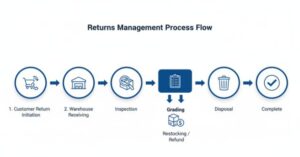
Customer returns initiation and return authorization
The process starts when a customer starts a return through a self-service returns portal or support team. A return authorization (RMA) is generated along with a return label, making the process simple and trackable.
Clear returns policy guidelines help decrease confusion and improve transparency for both customers and businesses.
Warehouse returns receipt, scanning, and inspection
Once the item reaches the warehouse, it returns to the warehouse. Each parcel is scanned at the dock and matched to the original order using a warehouse management system (WMS) or a returns management system (RMS).
The product then goes through a detailed inspection to assess its condition. This step ensures proper tracking, compliance, and accurate inventory updates.
Grading, restocking, and final disposition
After inspection, items are categorized based on condition:
- Resellable inventory → Restocking
- Minor issues → Repackaging or refurbishment
- Damaged goods → Recycling or disposal
- Unsellable → Liquidation
This stage is serious for value recovery and inventory reconciliation, helping businesses reduce losses and maximize returns from products.
Refunds, exchanges, and customer communication
Once the decision is made, the system triggers a refund, replacement, or exchange through the OMS or ERP integration.
Fast communication improves trust. Customers receive updates, guaranteeing full visibility and reducing support queries.
Returns Management Best Practices for 3PL Operations
Set clear SLAs for processing speed
Every effective 3PL process depends on strict processing SLA timelines. For example:
- Inspection within 24–48 hours
- The refund was triggered the same day
This reduces delays and keeps customers satisfied.
Use WMS integration for visibility and accuracy
A connected WMS, RMS, and OMS setup ensures real-time updates. It improves:
- Accuracy
- Tracking
- Reporting
This level of integration is important for modern 3PL management.
Create grading rules for every product type
Not all products follow the same marking logic. Define clear grading values to avoid:
- Unnecessary disposal
- Incorrect restocking
This expands returns processing consistency and defends margins.
Track return reasons and recovery rates
Understanding return reasons helps businesses reduce future returns. With proper analytics and reporting, you can recognize patterns like the following:
- Product defects
- Incorrect sizing
- Damaged goods
This leads to smarter choices and better product quality.
Why Brands Use a Returns Management Service
Lower operational workload
Handling returns inside can drain time and resources. A professional returns management service takes over the entire process, allowing your team to focus on growth.
Faster handling of customer returns
With a dedicated 3PL, customer returns are managed quickly and efficiently, reducing refund delays and improving buyer confidence.
Better stock recovery and warehouse efficiency
Specialist providers optimize returns handling, guaranteeing maximum resaleable inventory recovery and minimal waste.
Improved customer experience
Fast refunds, clear communication, and dependable service lead to better customer satisfaction, which directly affects repeat purchases.
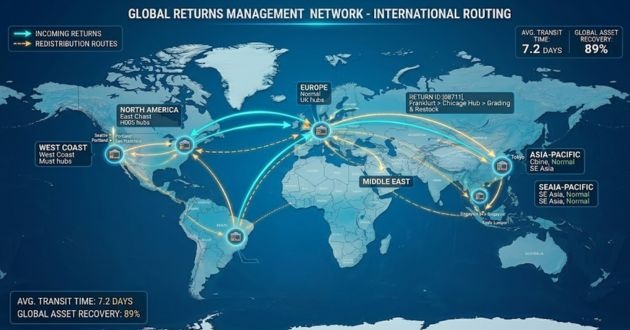
International Returns Management: What Changes Across Borders

Customs documents and return labels
In international returns management, customs paperwork becomes essential. Incorrect documentation can significantly delay the return process.
Local return addresses and local carriers
Offering local return options reduces shipping costs and speeds up the process. This improves the overall customer returns experience.
Cross-border visibility and tracking
Tracking international returns needs advanced systems for full visibility across limits. This guarantees better control and fewer lost items.
International returns costs and customer expectations
Global returns are more expensive. Businesses must balance cost with service quality to preserve customer trust.
3PL Returns vs In-House Returns Management
Control and flexibility
In-house gives full control, while 3PL management depends on defined developments and SLAs.
Costs and scalability
A 3PL process scales easily with demand, while in-house operations require additional staff and space.
When a 3PL process makes more sense
- Standardized products
- Multiple locations
- High return volume
When in-house returns are better
- Custom inspection needs
- Warranty claims
- Complex products
Common Warehouse Returns Problems and How to Fix Them
Slow inspections
Inspection delays slow down refunds. Solution: dedicated returns zone and trained staff.
Inventory mismatches
Incorrect data leads to stock issues. Solution: real-time inventory reconciliation via WMS.
Unidentified customer returns
Missing RMA reasons confusion. Solution: mandatory return authorization and dock scanning.
Poor exception handling
Items without strong classification get stuck. Solution: strong exception handling workflows and growth paths.
Final Thoughts
A well-structured returns system is more than just a cost center; it’s a modest advantage. Whether you manage returns in-house or use a returns management service, success depends on speed, accuracy, and visibility.
For UK businesses aiming to scale, combining strong 3PL management, efficient warehouse returns, and smart international returns management strategies will ensure long-term growth and customer loyalty.
Frequently asked questions
What is the difference between returns management and reverse logistics?
Returns management concentrates on handling returned goods, while the same logistics covers the whole backward supply chain.
What does a returns management service include?
A returns management service contains receiving goods, inspection, grading, restocking, disposal, and refund processing.
How does a 3PL process customer returns?
A 3PL process contains receiving returns, inspection, grading, inventory updates, and starting refunds.
What systems are used to manage warehouse returns?
Businesses use WMS, RMS, OMS, and ERP integration for handling warehouse returns professionally.
How do international returns management services work?
International returns management includes cross-border shipping, customs handling, local return centers, and tracking systems.
How quickly should customer returns be processed?
The best practice is within 24–48 hours from receiving to inspection and refund start.
Why is returns management important for e-commerce businesses?
Efficient returns management reduces costs, improves customer trust, and defends long-term productivity.
