



EORI Number Explained: Do You Need One to Sell in the UK?

The UK is one of the most attractive e-commerce markets in the world, with online retail spend passing £ 200 billion a year. For international sellers, whether you’re based in Pakistan, the US, the EU, or anywhere else, that scale is hard to ignore. But before a single box crosses the border, there’s a piece of paperwork almost every overseas seller runs into: the EORI number.
If you’re new to importing or exporting, the term can be confusing. Is it the same as a VAT number? Does every business need one? What happens if you skip it? This guide answers all of that in plain English, with the latest information straight from HMRC, so you can plan your UK launch without unexpected customs delays.
What Is an EORI Number?
EORI stands for Economic Operators Registration and Identification number. It’s a unique ID issued by HM Revenue and Customs (HMRC) that customs authorities use to identify businesses and individuals moving goods across borders.
Think of it as a passport number for your business, not for you personally, but for every shipment your business sends into or out of the UK. Without it, customs has no way to formally recognize who’s responsible for the goods crossing the border, which means those goods legally cannot be cleared.
A UK EORI number always starts with the prefix “GB,” followed by 12 digits (for example, GB123456789000). If your business is VAT-registered in the UK, your EORI is usually just your VAT number with “GB” added at the front and “000” at the end.
Why International Sellers Should Care About This
If you’re running an e-commerce brand outside the UK and shipping products to UK customers, or importing stock into a UK warehouse before you sell it, you are almost certainly involved in “economic activity” that requires an EORI number.
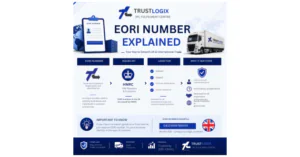
Here’s a simplified version of what that supply chain journey looks like:
Overseas supplier → international shipping → UK customs → UK warehouse → pick & pack → customer delivery
The EORI number sits at the customs stage of that journey. Skip it, and everything downstream, your warehouse receiving, your order fulfilment, your delivery promises to customers, gets delayed too.
This matters even more once your order volume grows. A handful of delayed shipments might be a minor inconvenience. Hundreds of delayed orders during a peak sales period can damage customer trust and cost real revenue.
Who Actually Needs an EORI Number?
UK-Based Businesses Importing Goods
Any UK company bringing in stock from overseas suppliers, clothing brands sourcing from manufacturers abroad, electronics retailers importing from Asia, or businesses buying from EU suppliers generally needs a GB EORI number to clear customs.
International Sellers Shipping Into the UK
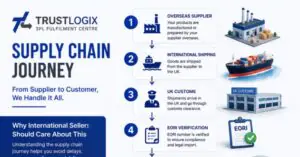
This is the group most readers of this guide fall into. If your business is based outside the UK and you’re importing goods into Great Britain (England, Scotland, and Wales), including from the EU, the US, or anywhere else, you need a GB EORI number to move those goods legally.
The good news: non-UK businesses can apply for a GB EORI without needing a UK Unique Taxpayer Reference (UTR), Standard Industrial Classification (SIC) code, or National Insurance number. HMRC’s application process accounts for overseas applicants.
E-commerce Sellers on Shopify, Amazon, WooCommerce, and Marketplaces
If you import inventory before selling it to UK customers, regardless of which platform you sell on, you’ll typically need an EORI number to bring that stock into the country in the first place.
Sole Traders and Small Businesses
Being small doesn’t exempt you from customs rules. If a sole trader imports goods for resale, they need an EORI number just like a larger company.
Private Individuals
If you’re buying something for personal use only, not for resale, you generally do not need an EORI number. The requirement is tied to commercial, not personal, activity.
GB EORI vs. XI EORI: What’s the Difference?
This trips up a lot of international sellers. There are two types of EORI numbers relevant to UK trade:
- GB EORI: required for moving goods between Great Britain (England, Scotland, Wales) and any other country, including the EU.
- XI EORI: only needed if you move goods specifically between Great Britain and Northern Ireland. You must already hold a GB EORI before you can apply for an XI EORI.
Most international sellers shipping to mainland UK warehouses only need the GB EORI. The XI EORI is a separate, additional registration relevant to a smaller subset of businesses trading with Northern Ireland.
Is an EORI Number the Same as a VAT Number?
No, and this is one of the most common points of confusion.
A VAT number relates to tax registration and how you charge/reclaim VAT. An EORI number relates to customs identification and clearance. They serve different government functions, even though if you’re VAT-registered, your EORI number is often derived directly from your VAT number.
A business can be VAT-registered without ever needing an EORI (if it never imports or exports). Equally, a business can hold an EORI without being VAT-registered. They’re related, but not interchangeable.
How Much Does an EORI Number Cost?
Nothing. Applying for an EORI number through the official GOV.UK website is completely free. There is no government fee involved. If you come across a third party charging a large fee just to “process” your EORI application, apply directly through GOV.UK instead; the process is designed to be self-service.
How Long Does It Take to Get an EORI Number?
This is one of the most searched questions on this topic, so here are the real numbers:
- The online application typically takes around 10–15 minutes to complete if you have your business details ready.
- If you’re VAT-registered, your GB EORI number is often issued immediately upon submission, since HMRC can generate it from your existing VAT record.
- If you’re not VAT-registered, or if HMRC needs to run extra checks on your application, it can take up to 5 working days.
- An XI EORI number (for Northern Ireland trade) also typically takes up to 5 working days and can only be requested after your GB EORI is already issued.
Because of this, the safest approach is to apply well before your first shipment leaves your supplier, not after it’s already in transit.
How to Apply for an EORI Number
You apply directly and only through the official GOV.UK service: Get an EORI number – GOV.UK.
Here’s what the process generally looks like:
- Sign in or create a Government Gateway account. If you don’t already have one, you can set it up as part of the application.
- Confirm whether you’re applying as a business or an individual and whether your business is established in the UK or overseas.
- Provide your business details: name, address, and contact information. UK-based applicants will also need their UTR and SIC code (found via the Companies House register) and VAT details if applicable. Non-UK businesses can skip the UTR, SIC code, and National Insurance number entirely.
- Submit the application. In most cases, your GB EORI number appears on screen immediately. If HMRC needs to run additional checks, allow up to 5 working days.
- Save your EORI number securely and share it accurately with your freight forwarder, customs agent, or fulfillment partner; errors in this number are a common cause of shipment delays.
If you’re unsure whether you already have an EORI number (for example, if your business was VAT-registered before 2021), you can check using HMRC’s free EORI number checker before applying again.
What Happens If You Don’t Have One?
Skipping this step doesn’t just create paperwork problems; it stops your goods from moving. Without a valid EORI number, businesses can face the following:
- Shipments held at UK customs indefinitely
- Inability to complete import declarations
- Additional administrative delays and correspondence with HMRC
- Missed delivery windows during peak sales periods (Black Friday, Christmas, back-to-school, etc.)
- Extra storage or demurrage charges while goods sit uncleared
For a growing e-commerce brand, a single blocked shipment during a major sales campaign can mean lost revenue and frustrated customers who simply order from a competitor instead.
Common EORI Mistakes International Sellers Make
Applying too late. Many sellers only discover they need an EORI number once their stock is already in transit; by then, the delay is often unavoidable.
Confusing EORI with VAT registration. As covered above, these are separate registrations that serve different purposes. Assuming one covers the other is a frequent and costly mistake.
Not planning beyond customs clearance. Getting your goods through customs is only step one. Businesses still need a plan for UK warehousing, inventory management, order fulfillment, and returns once stock has legally entered the country.
Entering the wrong EORI format. A mistyped or mismatched EORI number on shipping documentation is a common, entirely avoidable cause of customs hold-ups.
From Customs Clearance to Customer Delivery: What Comes Next
An EORI number gets your goods legally into the UK. It doesn’t get them into your customers’ hands. That’s where the rest of your UK supply chain takes over: warehousing, inventory management, pick and pack, and last-mile delivery.
This is exactly where a UK-based 3PL (third-party logistics) partner like TrustLogix fits into the picture. Once your goods clear customs, Trustlogix can take over with the following:
- Fulfilment centre services: including Amazon FBA preparation, so your stock is inspected and prepped correctly on arrival
- Inventory management: with real-time stock visibility, so you always know what’s on hand
- Secure UK warehousing: with flexible storage as your order volume grows
- Branded real-time tracking: for a better post-purchase customer experience
- Returns management: including a local UK return address and streamlined reverse logistics
- Platform integrations with Shopify, Amazon, WooCommerce, TikTok Shop, eBay, and Etsy
For international brands entering the UK market for the first time, pairing correct EORI registration with an experienced fulfillment partner is the difference between a smooth launch and a stressful one.
Final Thoughts
For any business selling into the UK from overseas, the EORI number is one of the first and most important administrative steps to get right. It’s free, it’s quick to apply for, and getting it sorted early removes one of the most common causes of shipment delays for new-to-market sellers.
But customs clearance is only the beginning of the journey. Once your goods are legally in the country, you still need somewhere reliable to store them, pick and pack them, and get them to your customers on time. That’s where a dedicated UK fulfillment partner becomes just as important as the paperwork itself.
Frequently Asked Questions
What is an EORI number in the UK?
An EORI (Economic Operators Registration and Identification) number is a unique ID issued by HMRC that identifies businesses and individuals for customs purposes when importing or exporting goods.
Who needs an EORI number to sell in the UK?
Any business, UK-based or international, that imports goods into Great Britain or exports goods from it generally needs a GB EORI number. This includes e-commerce sellers, retailers, manufacturers, and sole traders.
Is getting an EORI number free?
Yes. Applying through the official GOV.UK website carries no government fee.
How long does it take to get an EORI number?
If you’re VAT-registered, it’s often issued immediately. If not, or if HMRC needs additional checks, it can take up to 5 working days.
Is an EORI number the same as a VAT number?
No. A VAT number relates to tax; an EORI number relates to customs identification. A business can have one without the other, though VAT-registered businesses often have an EORI derived from their VAT number.
Do private individuals need an EORI number?
No, not for personal, non-commercial imports. The requirement applies to commercial activity, such as importing goods for resale.
Can I import goods into the UK without an EORI number?
Not legally, if a customs declaration is required. Your shipment will be held at the border until valid EORI details are provided.
Do I need a GB EORI and an XI EORI?
Only if your goods move specifically between Great Britain and Northern Ireland. Most international sellers shipping to UK warehouses only need a GB EORI.
Planning to sell into the UK and need help with the logistics side once your goods clear customs? Get a free fulfillment quote from TrustLogix or get in touch with our team to talk through your UK launch.
