



Shopify Shipping UK: Rates, Delivery Options, Labels & Setup

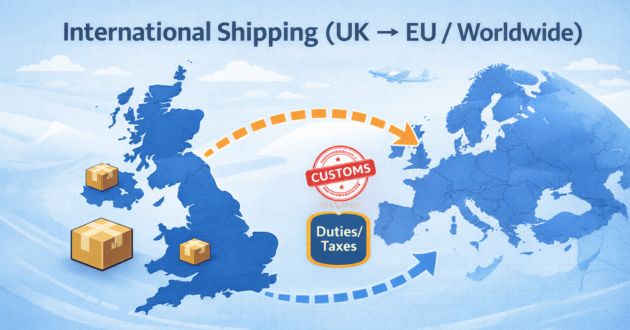
If you’re selling in the UK, your shipping setup isn’t “just admin work.” It directly affects conversions, returns, and reviews. This Trustlogix guide shows how to set up Shopify shipping UK properly, explain shopify rates UK, and avoids the most common checkout + fulfilment mistakes.
Shopify Shipping UK: What It Is (and How It Relates to Shopify Fulfilment)
Shopify lets you manage shipping rules, delivery options, and fulfillment locations from Shipping and delivery inside your admin. Those settings control what customers see at checkout, how rates are calculated, and which location ships the order.
Shopify shipping vs order fulfilment (in-house vs outsourced)
Think of it like this:
- Shipping = what the customer chooses at checkout (Standard / Tracked / Express), plus your rates, delivery timelines, and labels.
- Fulfillment = the behind-the-scenes work: order processing, picking, packing, dispatch, and returns.
If your self-ship, you’re doing Shopify fulfilment in-house (from home, office, or a small warehouse). If you outsource, a 3PL UK or fulfilment warehouse UK handles pick and pack UK, storage, dispatch, and returns fulfilment UK.
When the shipping setup becomes a scaling bottleneck
Shipping becomes a bottleneck when:
- You can’t keep up with the dispatch cut-off time (late shipments = refunds + bad reviews).
- Your checkout shows the wrong rates (cart abandonment goes up).
- You’re getting stockouts/backorders because inventory isn’t synced well (inventory management, Shopify inventory sync, reorder points).
- Returns are chaotic (no returns portal, no RAM process, slow refunds).
At that point, many UK stores move to Shopify fulfilment services UK / Shopify fulfillment services UK (outsourced) or a multi-location setup.
Before You Start: UK Shipping Setup Checklist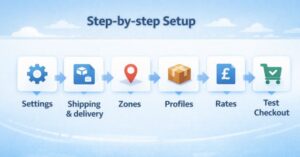
Product weights, package sizes, processing time (why it matters for accurate rates)
Before touching rates, get your basics right:
- Product weights + dimensions (even rough is better than blank)
- Common box/poly mailer sizes (for accurate carrier calculations)
- Processing time (same day dispatch? 24–48 hours? made-to-order?)
- SKU + barcode discipline (sku management, skus, barcodes, barcode scanning)
Why it matters: Shopify shipping settings can utilize package data to enhance rate accuracy, and you can also provide more accurate delivery estimates when processing times align with reality.
Shopify Shipping UK& delivery settings location
Path (most stores):
Shopify admin → Settings → Shipping and delivery
From there, you can:
- Create shipping rates (flat, free, or calculated)
- Use shipping profiles for product-based rules
- Set packages, processing times, and delivery dates
- Configure locations and order routing
Delivery Options UK Customers Expect (Standard, Express, Tracked, Pickup)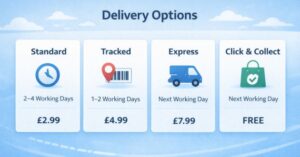
Standard vs express vs tracked (what to offer on checkout)
A clean checkout usually has 2–3 options:
- Standard (2–5 working days)
- Tracked (adds tracking notifications, reduces “where is my order?” tickets)
- Express (next-day shipping / two-day delivery)
If you can operationally support it, “next day delivery uk” and “same day dispatch uk” can lift conversions—BUT only if your dispatch cut-off time is realistic and consistent.
Helpful checkout wording:
- “Standard (2–4 working days)”
- “Tracked (2–3 working days).”
- “Express (Next working day if ordered before 2 pm).”
This also ties to last-mile delivery expectations and delivery time estimates.
Local delivery & store pickup (if applicable)
If you have a local customer base:
- Enable local delivery
- Add store pickup / click and collect
- Consider pickup points (third-party networks)
Local options can reduce shipping costs and improve customer satisfaction, especially in areas such as London and other densely populated regions.
Step-by-Step: Set Up Shopify Shipping UK (Zones, Profiles, Rates)
Create shipping profiles (product-based shipping setup)
Use shipping profiles when:
- Some items are oversized/fragile (special packaging)
- Some products ship from a different location
- You sell subscription boxes (subscription box fulfilment) or bundles (kitting and assembly)
Shipping profiles let you assign different rates to specific items.
Example:
- Profile A: “Small parcels” (flat + free threshold)
- Profile B: “Oversized items” (weight-based / price-based)
Create shipping zones (UK, EU, Rest of World)
Common zones:
- United Kingdom
- EU
- Rest of World
If you ship UK to EU shipping, keep it separate so you can control messaging for customs and returns.
Add shipping rates (free, flat, weight-based, price-based)
Your core options:
| Rate type | Best for | Notes |
| Free shipping | Raising conversion | Add minimum order value to protect margin |
| Flat rate | Simple checkout | Great for predictable parcels |
| Weight-based | Mixed catalogue | Needs accurate weights |
| Price-based | AOV strategy | “Free over £X” works well |
| Calculated rates | Real-time accuracy | Depends on plan + carrier/app |
Shopify explicitly supports creating flat, free, and carrier-calculated rates and using shipping profiles for different products.
Show delivery dates + processing time alignment (avoid wrong expectations)
Do this to reduce disputes:
- Set processing times (when you actually ship)
- Show delivery estimates at checkout (transit + processing)
- Send tracking notifications
Shopify supports setting processing times, delivery dates, and customer notifications from the admin.
Carrier-Calculated Shipping Rates in the UK (How It Works + Setup)
Requirements & eligibility (plan/feature dependent)
Carrier-calculated shipping is not available on every plan by default. Shopify notes that third-party carrier-calculated rates are supported on higher tiers (and not supported on some entry plans).
Practical takeaway:
- If you want real-time rates, check your plan eligibility first.
- If not eligible, use smart flat rates + weight tiers as a fallback.
How to create calculated rates (Use carrier/app to calculate)
Typical flow:
- Choose a carrier/app for calculated rates (courier integration)
- Connect it (app integration)
- Configure rules (service levels, exclusions, markups)
- Test at checkout with multiple addresses and baskets
If you’re technical, some setups use shopify api, webhooks, and rate apps to create advanced logic.
Add handling fee/markup/discount (profit-friendly rates)
Calculated rates are “cost-based,” not “profit-based.” Add:
- Handling fee (packaging + labor)
- Small markup for rural or heavy parcels
- Discount for high AOV baskets (to lift conversion)
UK supported calculated-rate carriers (brief mention only)
Carrier availability changes and can depend on your fulfilment origin and the apps you use. Best practice: check what’s supported inside your Shopify admin and the rate-app documentation before building your pricing model.
Shipping Labels in the UK: How to Buy, Print, and Track (Inside Shopify)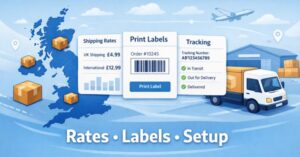
Labels workflow in Shopify admin (order → label → tracking)
A simple workflow:
- Order paid
- Pack (packing slips, branded packaging)
- Buy/print label
- Dispatch
- Customer gets tracking notifications
Shopify Shipping label purchase is available for fulfilment locations in multiple regions, including the UK (depending on eligibility and setup).
Packaging, label formats, and common label mistakes
To reduce returns and damage:
- Use the right packaging size (avoid “floating” items)
- Add fragile packing for breakables
- Use branded packaging and custom inserts for repeat purchase
- Keep labels flat and scannable
Ops upgrades that improve speed + accuracy:
- Barcode scanning
- Batch picking/zone picking
- Packing slips that match the order exactly
International labels & customs basics (UK shipping reality)
If you ship cross-border:
- Make your product data clean (weights, descriptions)
- Be ready for customs clearance, duties and taxes
- Decide how you’ll handle DDP shipping vs DDU shipping
- Consider the terms UK VAT, EORI number, and HMRC requirements (get professional guidance if unsure)
International Shipping From the UK: EU, Worldwide, and Returns Impact
Customs, duties, and delivery-time communication
What customers hate most is surprise costs or vague tracking.
Do this:
- Clearly show delivery time estimates (don’t promise “2 days” worldwide)
- Add an “international shipping” section in your policy
- Explain who pays duties/taxes (simple language)
If you’re growing, consider international fulfillment via multiple warehouse locations so you can keep inventory closer to buyers.
Returns flow for international customers (reduce support load)
International returns can drain margins fast unless you design the process:
- Use a returns portal (self-serve)
- Create an RMA process (return approval + tracking)
- Decide if you offer return-to-UK or local returns consolidation
- Track reverse logistics costs and restocking rules
Shopify Fulfilment UK: Best Fulfilment Options (In-House vs 3PL vs multi-location)
When to switch from self-fulfillment to outsourced fulfillment
You’re ready for shopify fulfilment uk / Shopify Fulfillment UK outsourcing when:
- Orders exceed your daily capacity
- You miss the dispatch cut-off time often
- Storage is a problem (Warehousing UK, Storage and fulfilment UK)
- Returns take too much time
- You want next-day delivery uk consistently
A strong provider in e-commerce fulfilment UK typically offers:
- UK fulfillment center / UK fulfillment center options
- Pick and pack UK
- Packaging services UK
- B2B fulfilment UK and FBM fulfilment UK (if you sell on marketplaces too)
- Multi-channel fulfilment support
If you serve multiple cities, ask about UK warehouse locations near demand (London fulfilment, Manchester fulfilment, Birmingham fulfilment, Leeds fulfilment, Glasgow fulfilment, Edinburgh fulfilment, Bristol fulfilment).
Multi-location inventory + shipping logic (how it affects rates)
Multi-location setups are powerful, but only if inventory is accurate:
- Real-time stock: avoid stockouts and backorders
- Order routing rules (nearest location, available inventory)
- WMS integration (warehouse management system, Wms integration)
- FIFO / lot tracking (if your products need it)
This is where Shopify logistics UK becomes a system, not a scramble.
Shopify Rates UK & Shopify Charges UK: What Costs to Expect
Subscription plan cost vs shipping costs (don’t mix them)
Keep these separate in your budgeting:
- Platform subscription (your Shopify plan)
- Payment processing fees (varies by setup)
- Shipping costs (labels, courier bills)
- Packaging materials
- Labour (in-house) or fulfillment fees (outsourced)
Many stores confuse Shopify charges with shipping costs. Treat shipping like a cost center you can optimize.
Shipping labels, packaging, handling fees (real-world cost buckets)
Typical “shipping stack” costs include:
- Shipping labels and carrier fees
- Packaging services UK (boxes, tape, void fill)
- Handling and packing time
- Returns handling + reverse logistics
- Fulfilment costs UK (storage, inbound receiving, pick/pack fees)
If you use a 3PL:
- Ask for clear pricing (storage, pick/pack, returns, kitting)
- Ask about SLA (service level agreement sla), order accuracy, and dispatch cut-off time
Shopify Plus ecommerce platform: shipping features that matter (brief)
For larger stores, the Shopify plus ecommerce platform can be useful if you need:
- More control over checkout experiences
- More advanced integrations
- Higher operational flexibility for fast growth
(Choose based on needs, not hype.)
Shopify Shipping Policy Template (UK) + Delivery Terms
Shipping policy template sections (processing time, delivery times, costs, tracking)
Here’s a clean Shopify shipping policy template you can adapt:
Shipping & Delivery
- Processing time: Orders are processed in X–Y business days.
- Delivery times:
- Standard: X–Y business days
- Tracked: X–Y business days
- Express: X business day (order before [time])
- Shipping costs: Shown at checkout (free shipping may apply over £X).
- Tracking: Tracking is provided for tracked/express services. Tracking notifications are sent by email/SMS (if provided).
- Address accuracy: Customers are responsible for the correct address details.
- Delays: Carrier delays can occur during peak periods; we’ll help if an order is delayed.
What to write to reduce disputes/chargebacks
Add two powerful lines:
- “Delivery times are estimates and start after dispatch.”
- “If your order shows as delivered but you can’t find it, contact us within X days so we can assist.”
This reduces “I want a refund” messages caused by misunderstandings.
Returns & Shopify Exchange Policy (UK-Friendly Wording)
Returns window, condition rules, and refund timeline
A simple structure:
- Returns accepted within X days of delivery
- Items must be unused / in original packaging (if relevant)
- Refunds processed within X days after inspection
- Return shipping cost rules (who pays, and when)
If you outsource, make sure your partner supports returns fulfilment in the UK, so you’re not manually handling every parcel.
Exchange steps (size/variant exchange process)
A clear Shopify exchange flow:
- Customer requests an exchange in the returns portal
- They choose the size/variant
- You approve (or auto-approve)
- They return the item (or you do “ship-first” for VIP customers)
- Replacement ships after return scan or inspection
Keep the language simple. Confusion kills trust.
Troubleshooting: Shopify Shipping UK Problems (Rates Not Showing, Checkout Issues)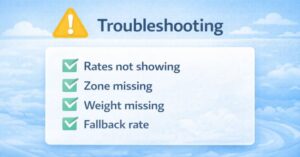
Why shipping rates don’t appear (most common causes)
Common causes:
- No shipping zone for the customer’s address
- No rate set for that product (shipping profile mismatch)
- Product weight missing or package setup incomplete
- The inventory location can’t fulfil the order due to the order routing rules
- Carrier/app downtime for calculated rates
Shopify notes that shipping rates, profiles, packages, locations, and order routing all affect what shows at checkout.
Backup rates (fallback rates if carrier/app fails)
Always add fallback options:
- A flat “Standard (Backup)” rate
- A flat “Express (Backup)” rate
- A clear support message if calculated rates fail
This prevents “No shipping options available” (the worst checkout error).
If you want, paste your product types (lightweight/oversized/fragile), average order value, and where you ship (UK only vs UK+EU). I’ll tailor the shipping rates model (flat/weight/threshold), plus a UK-friendly policy draft that matches your exact setup for Trustlogix.
Frequently asked questions
“How to close a Shopify store?” (short steps + what happens to shipping/labels)
How to close a Shopify store:
- Go to Settings → Plan in Shopify admin
- Choose Deactivate store
- Export what you need first (orders, reports)
After closure, you won’t be able to create new labels from that store. Download key records before deactivation.
“Do calculated rates show delivery time?”
Calculated rates usually return a shipping price and service level (depends on the carrier/app). Delivery time estimates should include:
- Your processing time (when you dispatch)
- Carrier transit time (after pickup)
Best practice: show delivery estimates at checkout and keep them realistic.
“Is Shopify Fulfilment Network available in the UK?”
Most write-ups describe SFN as optimized around a North America / US-focused network. UK merchants typically use UK-based fulfilment providers instead of expecting SFN to function like a dedicated UK network.
How do I set free shipping over a threshold in the UK?
Use a price-based shipping rate:
- “Free shipping over £X”
- Add a standard paid rate under £X
This improves AOV while protecting margin.
What’s the best checkout mix: Standard, Tracked, or Express?
For most UK stores:
- Standard (cheap)
- Tracked (popular)
- Express (premium)
Too many options can reduce conversions.
Do I need SKUs and barcodes for fulfilment?
If you’re scaling, yes. SKUs help with inventory tracking, and barcodes reduce picking mistakes—especially with batch picking and zone picking.
How do I reduce returns and “where is my parcel?” tickets?
- Offer tracked shipping
- Send tracking notifications
- Show delivery time estimates clearly
- Use a returns portal with an RMA process for fast resolution
